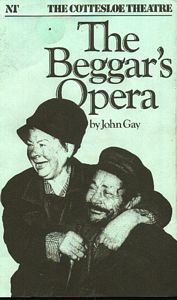
THE BEGGARS' OPERA by John Gay
Venue: National Theatre (Cottesloe) 1982
Company: NT
Directd by: Richard Eyre
Cast in order of speaking
Venue: National Theatre (Cottesloe) 1982
Company: NT
Directd by: Richard Eyre
Cast in order of speaking
| Beggar | William Armstrong |
| First Gentleman | Norman Warwick |
| Pickpocket | Kevin Williams |
| Second Gentleman | Kevin Quarmby |
| Fence | David Ryall |
| Irish Cockney sneak thief | Harry Towb |
| Pimp | Paul Jones |
| Peachum | Harry Towb |
| Filch | Kevin Williams |
| Mrs Peachum | June Watson |
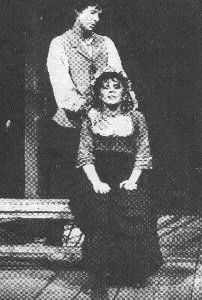
| Polly Peachum | Belinda Sinclair |
| Macheath | Paul Jones |
| Ben Budge | Larrington Walker |
| Matt of the Mint | Richard Walsh |
| Jemmy Twitcher | William Armstrong |
| Crook-Fingered Jack | Norman Warwick |
| War Dreary | Kevin Williams |
| Nimming Ned | Kevin Quarmhy |
| Harry Paddingron | Vincent Pickering |
| Drawer | Vincent Pickering |
| Jenny Diver | Fiona Hendley |
| Mrs Coaxer | Gail Rolfe |
| Mrs Vixen | Rachel Izen |
| Molly Brazen | Imelda Staunton |
| Dolly Trull | Belinda Sinclair |
| Suky Tawdry | Sally Cooper |
| Mrs Slammekin | June Watson |
| Lockit | David Ryall |
| Lucy Lockit | Imelda Staunton |
| Mrs Trapes | Irlin Hall |
| Gaoler | Kevin Quarmby |
Reviews
Times : Peter Ackroyd
Sentimental satire
The Beggar’s Opera has for some reason been moved to the mid-nineteenth century by the National Theatre, although I suppose it is a period that exerts a peculiar fascination for theatrical people after the success of Nicholas Nickleby. Perhaps the wardrobe department hired the old costumes.
John Gay’s opera is in many ways a very harsh affair, and contains a thesaurus of abuse against women in particular: poor Polly Peachum was called a baggage, a jade, slut, whore and hussy in the space of five minutes. And that was just the opinion of her parents. But this combination of rough demotic and pretty songs is always a potent one: this was pantomime of the gutter, a satire filled with sentiment. The only problem is that The Beggar’s Opera is not a very subtle work – Gay had a certain amount of trouble getting characters on and off stage, and when he is not being witty he is often banal.
The actors seemed to be enjoying themselves, though – but, then, that is what they are paid to do. Lots of cheap emotion was thrown across the stage in buckets, and even jades and whores became drenched in it. Paul Jones played Macheath: he looked convincing like a bull gone out to pasture, and his voice would have stopped a stagecoach dead in its tracks. June Watson was particularly good as Mrs Peachum. In any case, everyone loves a good melodrama, especially when it can be vaguely associated with “literature”, and the Beggars Opera still has enough life to attract even a television audience. And who could forget the wonderful song towards the end of the play, when the melody of Greensleeves is matched to a sombre meditation on Tyburn Tree?
Time Out: Ann McFerran
Richard Eyre partners his glorious revival of Guys and Dolls with an exuberant, faithful version of Gay's comedy of low life The Beggar's Opera. This production, set one hundred years on in Victorian England, boasts much quirkish detail - it's apparently lit by gaslamp and its highly accomplished ensemble playing almost quelled my somewhat contemporary qualms about the plot. John Gunter's atmospheric set transforms the Cottesloe into a vortex of grey, smoky streets dominated by a massive bridge where villainous beggars roam and evil deeds are done in back rooms; it's sort of East End before Nunn's Nickleby without the good guys. Harry Towb sneers a sly Peachum - his Northern Irish accent is quite perfect, while Imelda Staunton nearly busts a gut with her superb Lucy Locket, seized with furious desire to have her man even if he must hang for it. The action is dominated by Paul Jones's truly inspired Macheath, oozing Glaswegian guile and charm, obsessed with an almost manic lust 'I must have women'. Eyre's production of Gay's satiric opera is a blackish mirror to cast in the face of any ruling cast, but it will have the punters at the National's booking office for months to come.