THE HISTORY BOYS by Alan
Bennett
Venue: Milton Keynes 2005
Company: National Theatre
Musical Director: Tom Attwood
Directed by Nicholas Hytner/Simon Cox
Venue: Milton Keynes 2005
Company: National Theatre
Musical Director: Tom Attwood
Directed by Nicholas Hytner/Simon Cox
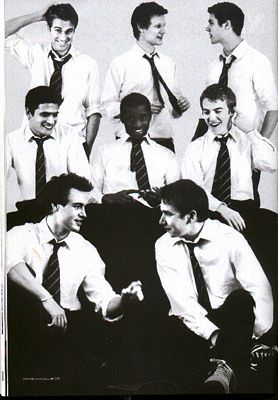
Cast
| Akhthar | Marc Elliott |
| Crowther | Kenny Thompson |
| Dakin | Jamie King |
| Lockwood | Matt Smith |
| Posner | Steven Webb |
| Rudge | Philip Correia |
| Scripps | Thomas Morrison |
| Timms | James Cartwright |
| Headmaster | Bruce Alexander |
| Mrs Lindott | Diane Fletcher |
| Hector | Desmond Barrit |
| Irwin | Tobias Menzies |
| TV Director | Derek Howard |
| Make-up Lady | Julia West |
| Other Boys | Leyland O'Brien David Poynor Samuel Yates |
| Pianist | Tom Attwood |
Reviews
This touring
production visiting Theatre Royal, Newcastle, reviewed
by Peter Lathan
With one South Bank Show, two Critics' Circle, two Evening Standard and three Olivier Awards (including, in each case, the award for best new play), there is little that the reviewer today can add to what has already been said about the play itself, except, perhaps, to comment on the accuracy of its portrayal of some schools and teachers. In his summary of 2004 in London theatre, Philip Fisher describes it as "Alan Bennett's comedy about school life in the 1950s (even if it was set in the 1980s)". That is true, but it is also true that the attitudes expressed by the teachers are just as current today. As a former teacher, I recognised both myself and my colleagues and, as for some of the things said by Hector and Mrs Lintott, I just want to know when Bennett was sitting in our staff room listening to our conversations!
This is a new cast, with Desmond Barrit replacing the much lauded and awarded Richard Griffiths as Hector. From all accounts, Griffiths was a hard act to follow but, for one who did not manage to see the original, Barrit certainly cuts the mustard. His Hector is crumpled in appearance, dismissive of current educational trends but filled with a love of literature and, in particular, a zeal to "pass it on". His somewhat cynical exterior belies the passion underneath and his comment towards the end about no longer seeing boys as boys but as work strikes a real spark of sympathy from the audience.
Tobias Menzies's Irwin, the young supply teacher, is the antithesis of all that Hector stands for and, although his attitudes (very modern and manipulative) are more successful than Hector's, he is a considerably less attractive figure. Menzies' performance, varying from the fully-fledged spin-doctor politician in the opening to the same in somewhat nervous embryo as he begins his teaching career (which is built on a half-truth), is entirely convincing.
It would have been easy for Bruce Alexander to play the Headteacher as a stereotype - if only because many Heads actually do stereotype themselves after some years in the job - with his obsession with image and league tables, and, although there are many moments (the thoughtless relegation of Posner to the floor in the photograph being a good example) when he is totally blind to human feelings, his handling of the Hector "situation" shows a surprising delicacy and humanity.
However the play stands or falls by the quality of performance from the eight boys, in particular Dakin, Posner, Rudge and Scripps. Simon Cox, who recreated the production from Nicholas Hytner's original direction, has created a very tight and effective ensemble and their banter (with the staff and each other) really rings true. As Posner, the gay ("Is it a phase?") Jewish boy, Steven Webb has an appealing vulnerability - and an attractive singing voice - whilst Jamie King's Dakin is full of the unconscious arrogance which is the hallmark of the popular boy. As Rudge, Philip Correia returns to his home territory after his three years at LAMDA and plays a down-to-earth, rough-edged Geordie lad who is quick to learn from the devious Irwin with just enough humour to appeal to the audience. Thomas Morrison's Scripps' light mockery of his religious pose is entirely convincing.
An award winning play, then, with what could have been an award winning cast, but for the fact that this is a revival. But there's always the TMA Awards for touring.
*
* * * *
Reviewed in Glasgow by Jay Dee.
A joy to watch
Reviewed in Glasgow by Jay Dee.
A joy to watch
I will always remember my school history teacher. Her name was Mrs Matthews and she was truly inspirational. She had that rare gift of both a passion for her subject and the ability to communicate that passion to her students. Her teaching has stayed with me and marked me. The power that such people have to influence young minds is just one of the themes explored in Alan Bennett's The History Boys, currently playing at the Theatre Royal in Glasgow.
The play deals with a group of young boys preparing to take the entrance exam to study history at Oxbridge, and with the teachers whose job it is to guide them. Beautifully written, the play manages to be complicated and challenging as well as tender and even tragic. Hector, a flawed hero - worshipped by his students, a teacher of the old school is contrasted with Irwin, the flash youngster whose teachings generally involve subverting whatever question is asked until it fits the (not always relevant) knowledge that you have.
The acting in this production is uniformly superb. It is inspiring to see a cast so wholly committed to a play. Desmond Barrit, as Hector, gives a performance full of nuance and subtlety, engendering sympathy for a man whose behaviour towards young boys is not always appropriate. Among the younger members of the cast the standout is Steven Webb, whose troubled homosexual teenager is played with warmth and a delicate touch and includes some rather lovely singing.
The production is cleverly designed by Bob Crowley - four flats are moved fluidly around the stage to create classrooms and cloakrooms and staffrooms. Scene changes are covered by video footage of the characters, a device which for me sounded the only weak note of the production - the video doesn't seem to progress as the play does, images are repeated and more than once I found my attention straying from the video to the scurrying figures moving the set. This was a small thing and didn't detract from what is an excellent piece of theatre and one that is a joy to watch, being both funny and thought provoking. See it where and while you can.