THE DRESSER by Ronald
Harwood
Venue: Watford Palace 2008
Director: Di Trevis
Venue: Watford Palace 2008
Director: Di Trevis
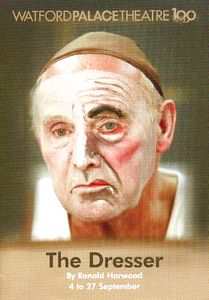
| Backstage in a provincial theatre an ageing actor-manager, known to his company as Sir, is struggling to find the strength to make it to the stage for his 227th performance of King Lear. With 30 minutes to curtain-up, air-raid sirens sounding and the best actors having been 'called up', Sir is crumbling. Devoted dresser Norman must once again rally the unpredictable star whose grip on sanity is becoming increasingly precarious. For 16 years Norman has been there to fix Sir's wig, massage his ego, remind him of his opening lines and help provide the sound effects for the storm scene on the blasted heath.... | |
| Cast in order of appearance | |
| Geoffrey Thornton |
Robin Hooper |
| Mr Oxenby |
Christopher Kelham |
| Her Ladyship |
Sarah Berger |
| Norman |
Graham Turner |
| Madge |
Penelope Beaumont |
| Sir |
Clive Francis |
| Irene |
Sasha Higgins |
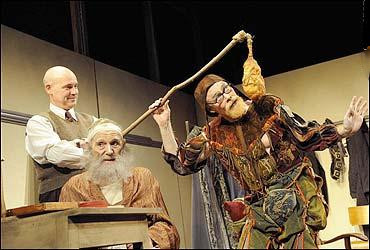
Graham Turner, Clive Francis , Christopher Kelham
Reviews
The Times: Dominic
Maxwell
Has there ever been a better backstage drama than Ronald Harwood’s 1980 play? It’s not remorselessly funny like Noises Off, though its gloriously lippy dialogue deserves a curtain call of its own. And yet its depiction of two men, both blotting out the real world through commitment to their craft, is a study of tunnel vision that’s both satirical and sympathetic.
Di Trevis’s revival has the odd wobble at the edges — it can be hard to depict actorliness without succumbing to actorliness — but is motored by a fine central performance by Clive Francis. He plays Sir, a megaphonic actor-manager much like the late Sir Donald Wolfit, for whom Harwood once worked as a dresser. A stage performer to his fingernails — “They haven’t built a big enough camera to record me!” — Sir takes Shakespeare to the wartime masses, leaving his sickbed to give his white-haired, shuffling Lear to the people of Liverpool. Flirty then feeble, imperious and then incapable, Sir rages against the dying of the light even as he faces up to its inevitability. His wife (Sarah Berger), playing a creaky Cordelia, wants out of this peripatetic life. But the play’s meat is the push-pull between Sir and his dresser Norman, played with a fiddly tenacity by Graham Turner, purveyor of a camp capacity to cope that keeps his master in line and his mind off what he’ll do without him. “We have to face facts,” says Penelope Beaumont’s lovelorn stage manager. “I’ve never done that in my life!” retorts Norman.
Francis’s performance is huge but not ham — Harwood is superb at tracing the shifting hierarchies of the workplace. Sir is an egomaniac, but how else could he function? When he’s not on stage, the cast can strain for effect, but Trevis orchestrates the play within a play, which we see from the wings, to be endearingly overblown rather than sniggeringly awful. Finally, it’s more fully realised in its comedy than in its tragedy — you’re more likely to be stimulated than devastated. But this is a backstage drama that truly understands the compulsion with which people define themselves by their work, that nails the need for solidity that motivates the restlessness of creativity. A good play, not far off a great play, given a very solid revival.
* * * * *
The Dresser is the ultimate backstage drama, written from first hand experience by Ronald Harwood, once dresser to notorious actor-manager Sir Donald Wolfit. It’s a beautifully crafted play and, like Clive Francis, I was lucky enough to see the original production in 1980 with Freddie Jones as Sir, and Tom Courtenay, who went on to play the title role on Broadway and was nominated for an Oscar for his film portrayal.
Now I consider myself just as lucky to have seen Clive Francis as the irascible tragedian who struggles to keep his sanity and play his 227th King Lear - with much cajoling from his faithful dresser, Norman. Francis’ performance is nothing short of magnificent, a true tour de force. He dons the cloak of senility so convincingly that when he says the life blood is draining out of him, you believe him and will him on, while his transformation as King Lear is equally amazing and gives us a fascinating lesson in the art of stage make-up. Usually second fiddle to the dresser of the title, in this production he makes the role every bit as compelling, even though Graham Turner’s sensitively acted performance, with its camp humour, matches any that have gone before him. With an fine supporting cast, this is indeed a special treat for any theatre-lover, and a worthy production with which to celebrate a 100th anniversary.
* * * * *
Daily Telegraph: Dominic Cavendish
In Watford, Di Trevis gives us another assured revival of a modern classic - Ronald Harwood's The Dresser (1980) - which would do well to transfer (to the West End). Clive Francis plays the old actor-manager - disintegrating before a performance of King Lear in some nameless backwater in 1942. He can't go on, he must go on. Fussing and clucking over him, his dresser Norman looks like he's seen it all before but, as he knocks back the brandy, we realise he's putting on a show too, aware that it could be curtains for both of them. Hand ever clasped to cheek, Graham Turner's camp, neurotic lackey matches Francis for affectation. Their glorious double act, embellished by walk-ons from other minutely observed thespian types, pays expert, affectionate homage to a self-absorbed species that strutted and fretted its hour upon the British stage and then was heard no more.