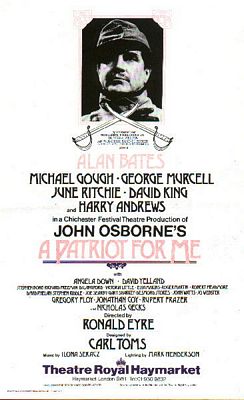
A PATRIOT FOR ME
by John Osborne
Venue: Theatre Royal Haymarket 1983
Directed by Ronald Eyre
Venue: Theatre Royal Haymarket 1983
Directed by Ronald Eyre
Cast
| Alfred Redl | Alan Bates |
| August Siczynski | David Yelland |
| Steinbauer | Roger Martin |
| Ludwig Max von Kupfer | Nicholas Gecks |
| Kupfer's Seconds | Rupert Frazer David Phelan |
| Lt. CoL Ludwig von MohI | David King |
| Adjutant | Gary Sharkey |
| Maximilian von Taussig | Jonathan Coy |
| Albrecht | Robert Meadmore |
| Whores | Elva Makins Victoria Little |
| Anna | Di Langford |
| Hilde | Angela Down |
| Captain Stanitsin | Stephen Riddle |
| Colonel Oblensky | George Murcell |
| General von Hotzendorf | Harry Andrews |
| Countess Sophia Delyanoff | June Ritchie |
| Judge Advocate Jaroslav Kunz | Gregory Floy |
| Young Man in Cafe | Richard Freeman |
| Paul | Gary Sharkey |
| Baron von Epp | Michael Gough |
| Ferdy | Jo Webster |
| Figaro | John Watts |
| Lt.Stefan Kovacs | Rupert Frazer |
| Marie-Antoinette | David Yelland |
| Messalina | Robert Meadmore |
| Tsarina | Richard Freeman |
| Lady Godiva | Stephen Bone |
| Dr. Schoepfer | Jonathan Coy |
| 2nd Lt. Victor Jerzabek | Joe Searby |
| Orderly | David Phelan |
| Mischa Lipschutz | Stephen Bone |
| Mitzi Heigel | Victoria Little |
| Minister | Desmond Stokes |
| Deputies | Robert Meadmore Roger Martln Rupert Frazer John Watts David Yelland David Phelan |
Review
The Times: Anthony Masters
London theatregoers planning a visit to this year's Edinburgh Festival with its Vienna 1900 theme will find a fascinating appendix on the subject at home in the Haymarket. Transferred from Chichester with Alan Bates in the central role, John Osborne's chronicle-drama presents the rise and fall of Alfred Redl, the brilliant officer in the Austro-Hungarian army who shot himself in 1913 after a long career as a double agent. That society, and a critique of own as Osborne saw it, is made to embrace rich characterisations and so many themes that it is a teasing task to see what lies at the centre.
Working up from negligible beginnings by observance of army values, Redl finds that he is homosexual and, as success accelerates, pawns it in promiscuity until his opposite numbers in Russian espionage blackmail him into treachery. Homosexuality (another Osborne theme) in Franz Josef's Vienna, where half the officer class turn up in drag at an annual ball hosted by an ancient baron dressed as Queen Alexandra, seems a little victory of individuals against society.
Osborne also shows, unusually for him, a central character in baroque prosperity, accepting the life-lies of a professional career and paralleling them with cynicism in his personal life. Alan Bates marks the transition from the loving innocent beaten up by the accomplices of the first boy he sleeps with to the cynical, vicious exploiter of beauty and jealousy. As at Chichester, I felt a detachment and even staginess, sometimes, keeping him from a great performance; but the part suffers from the lack of focus resulting from the richness.
Of the recastings for London, June Ritchie's Countess is the most unfortunate, sailing through her doomed affair with Redl in the bad old West End coquettish acting style. Michael Gough's Baron lacks the iron strength (and cutting edge) of Nigel Stock; but, as a coarse cabbage of a duchess, he is funny, telling, and finally irresistible. In the Hofburg scenes where fanfares and flunkies provide a sly pre-echo of the Baron’s Mozartian drag fiesta, Harry Andrews’s General has now reached masterful assurance.