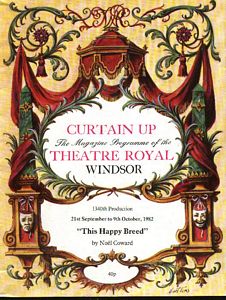
THIS HAPPY BREED by Noël Coward
Venue: Theatre Royal Windsor 1982
Directed by Patrick Tucker
Venue: Theatre Royal Windsor 1982
Directed by Patrick Tucker
| Frank Gibbons | David Harries |
| Ethel his wife | Jenny Logan |
| Sylvia his sister | Christine Ozanne |
| Vi & Queenie his children |
Melanie Parr Alison Frazer |
| Reg | Jason Kemp |
| Mrs Flint his mother-in-law | Mary Kerridge |
| Bob Mitchell | Robert East |
| Billy Mitchell | Tim Charrington |
| Sam Leadbitter | Michael Garner |
| Phyllis Blake | Amanda Mainard |
| Edie | Jill Simcox |
Review
Not just a piece of jingoism
Not just a piece of jingoism
Of the three plays presented by Noël Coward in that bleak war year of 1942, Present Laughter and Blithe Spirit have been going the rounds ever since. The third, This Happy Breed, has curiously been so neglected in the years between as to provide a rewarding surprise on the rare occasions we get an opportunity to view it. People with long memories are apt to dismiss it along with Cavalcade as jingoistic, and yet that is just what it is not, with the possible exception of Frank Gibbons' long speech to his grandson in a pram just prior to curtain fall. That, as an excess of wartime enthusiasm, is quite excusable; the remainder of the play remains as true as the day it was written, as a microcosm of life in the years between the wars (June 1919 to June 1939) in the Gibbons' house in Sycamore Road, Clapham Common.
Frank, his wife Ethel, sister Sylvia, children Vi, Queenie and Reg, the carping mother-in-law Mrs Flint are unexceptional people, leading unexceptional lives, but so truly and sympathetically observed that Coward reminds us that in all humanity there is dramatic interest, loving relationships in the most unexpected quarters, and above all, humour. The play is so well crafted, the dialogue so true to each individual, that it holds the interest in even an average repertory performance. But in this presentation every particular is of the highest quality and the effect is electrifying.
Under Patrick Tucker's guidance the cast do the playwright proud. David Harries and Jenny Logan bring Frank and Ethel to life so vividly one feels oneself a guest in their front parlour and Mary Kerridge presents the archetypal prophet of doom without ever straying near caricature - a fitting adversary to Christine Ozanne's totally real and awful Sylvia. The young people are individually excellent, especially Alison Frazer’s Queenie, Robert East and Tim Charrington, Bob and Billy, while Michael Garner’s Sam is the next-door neighbour to the life - all framed perfectly in John Page's admirably suitable set.