ANOTHER COUNTRY by Julian
Mitchell
Venue: Greenwich 1981
Directed by Stuart Burge
Venue: Greenwich 1981
Directed by Stuart Burge
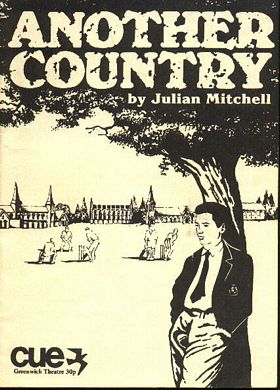
| World premiere of an absorbing new play by Julian Mitchell. Set in a great English public school in the 1930s, it explores with penetrating insight and humour an apparently exclusive society which comes to realize that it cannot ignore the world outside. The seeds of treachery and betrayal come under the microscope.... | |
| Cast in order of appearance | |
| Guy Bennett | Rupert Everett |
| Tommy Judd | Joshua Le Touzel |
| Donald Devenish | Piers Flint-Shipman |
| Jim Menzies | David Parfitt |
| Fowler | Michael Parkhouse |
| Sanderson | Christopher Villiers |
| Barclay | Matthew Solon |
| Delahay | Simon Dutton |
| Wharton | Gary Carp |
| Vaughan Cunningham | David William |
Review
On transfer to the Queen’s Theatre, Shaftesbury Avenue, with some cast changes
Observer: Robert Cushman
A Spy is born
The evening begins with an offstage boys' choir singing that great religious and patriotic hit I Vow to Thee My Country - first verse only. The second only comes round at the end of the show: and there's another country I've heard of long ago. I had always imagined that other country to be Heaven, but at the Queen's - where a performance of Julian Mitchell's play called Another Country is sandwiched between the two choruses - another interpretation suggests itself. By Mr Mitchell’s sardonic lights, that country, envisaged by his two central characters, could be Russia.
Our heroes are senior public schoolboys in the early 1930s One of them, Judd, is the school’s lone Marxist - or, the time being what it is, Stalinist - in a constant state of articulate fury over the system in general and the rules that stop him reading Das Kapital under the bedclothes in particular. The other, Guy Bennett, is a more complicated kind of rebel; in a milieu where casual homosexuality is the norm he makes the mistake of falling in love. His indiscretions land him a public flogging and (more woundingly) permanent exile from the school's privileged upper echelon. Recognising school to be a microcosm of the establishment world outside, he looks for a way of fighting back: covertly, since he doesn't want to lose any more perks. His eye falls on Judd's copy of Marx. A spy is born.
Mr Mitchell has written an acute, sympathetic and continuously entertaining play, one whose abundant joke-lines always remain in character. Its ultimate effect, though, depends on outside evidence. If I had not been alerted by the programme and the pre- publicity, I could easily have sat through the piece unaware that Guy Bennett was meant to be Guy Burgess. If you can identify the Bennett connection then you concentrate on him and get a coherent evening, rising to an abrupt but satisfying point. Mr Mitchell, though, wants you to be interested in other characters as well; and here both he and Stuart Burge's production - on a creaky revolve with variable acting - are less successful. It takes some time to sort out the personnel, and the conscientious torments of the retiring house captain never come into focus.
What does emerge is a properly ambiguous picture of a society thoroughly rotten (in both the literal and popular usages) and yet cosily attractive; Mr Mitchell offers us all the trappings of school fiction: the petty politics, the sport, the tormented fags (in the scholastic sense)who will be bullies themselves in time, the study teas. This, all too recognisably, is England; there is, unless you take desperate measures, no other country.
Guy's pale rebellion (born 30 years later he would be writing plays for subsidised theatres) is admirably caught by Rupert Everett, soft-voiced and hard-shelled; he is first glimpsed curled on the window ledge of the house library (shockingly short on books by the way) searching through binoculars for likely beloveds, his tie loose and his braces hanging down from his waist, a perfect self-created artefact. Kenneth Branagh brings great flair to Judd's decent doomed doggedness.